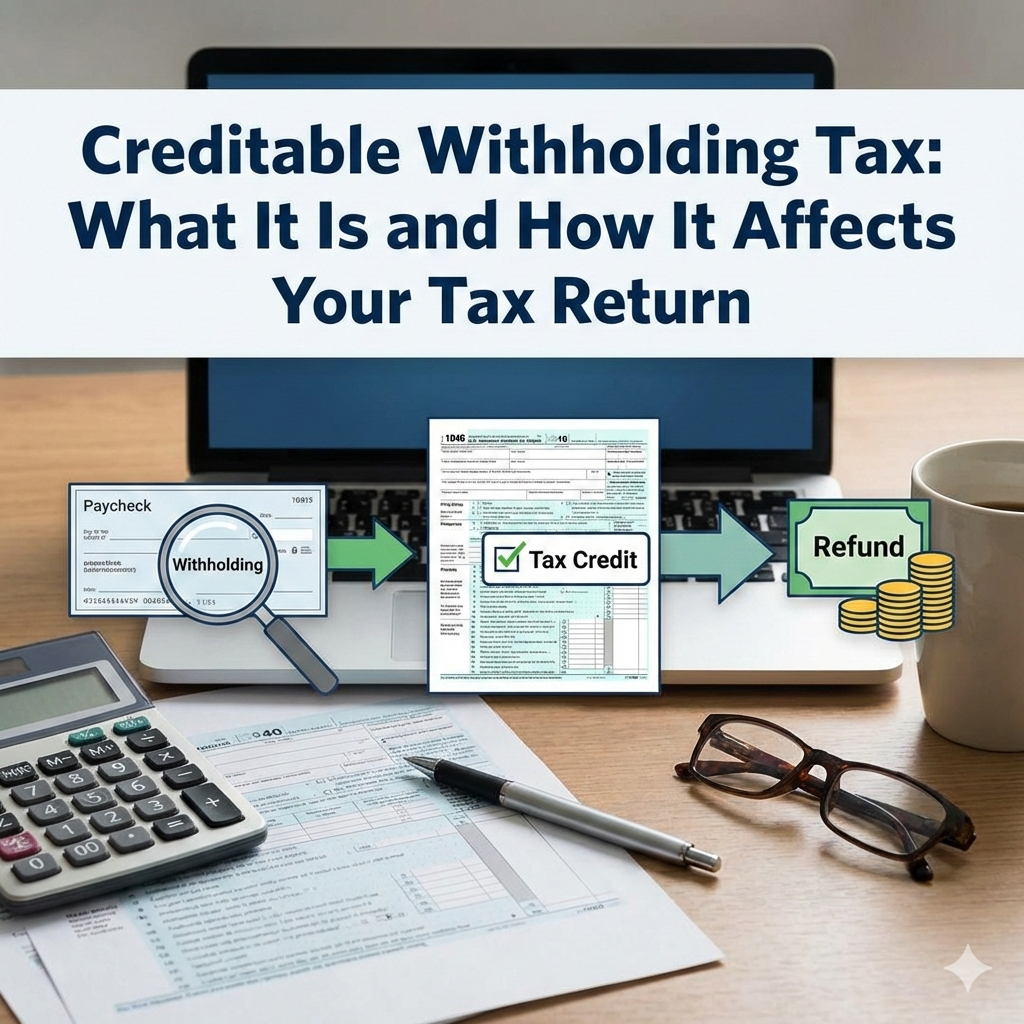
Understanding creditable withholding tax is essential for anyone who earns income, whether from employment, investments, or business activities. This tax mechanism affects millions of taxpayers each year, yet many people don't fully grasp how it works or how to properly claim credit for taxes already withheld. In this comprehensive guide, we'll break down everything you need to know about creditable withholding tax and how it impacts your overall tax liability.
Creditable withholding tax is money that's taken out of your income before you receive it and sent directly to the government on your behalf. The key word here is "creditable," which means you can claim credit for these withheld amounts when you file your tax return. Essentially, creditable withholding tax represents prepayment of your annual tax obligation.
When tax is withheld from your income throughout the year, you're paying your taxes incrementally rather than in one lump sum at year-end. When you file your tax return, you calculate your total tax liability for the year, then subtract the amount already withheld. If too much was withheld, you receive a refund. If too little was withheld, you owe the difference.
This system benefits both taxpayers and the government. Taxpayers avoid the burden of saving large amounts for a single annual tax payment, while the government receives steady revenue throughout the year. Understanding how creditable withholding tax works helps you better manage your cash flow and avoid surprises at tax time.
Several types of income are subject to creditable withholding tax, and understanding which apply to your situation is crucial for accurate tax planning and filing.
Income tax withholding is the most common form and applies to wages, salaries, and other employment compensation. Your employer calculates this withholding based on the information you provide on Form W-4, including your filing status and number of allowances.
Backup withholding occurs when you haven't provided a correct taxpayer identification number (TIN) to a payer, or when the IRS notifies the payer that you've underreported interest or dividend income. The current backup withholding rate is 24%, and it applies to various payment types including interest, dividends, and payments to independent contractors.
Withholding on investment income includes tax withheld from interest payments, dividend distributions, capital gain distributions, and other investment returns. Financial institutions automatically withhold these amounts and report them on forms like 1099-INT and 1099-DIV.
Withholding on retirement distributions applies when you take money from retirement accounts like 401(k)s, IRAs, or pensions. You can often choose the amount withheld, but there are mandatory minimums for certain distribution types. The default rate is typically 20% for eligible rollover distributions.
Withholding on gambling winnings applies to certain gambling proceeds, particularly when winnings exceed specific thresholds. Casinos, lotteries, and other gaming establishments withhold 24% on reportable winnings.
Foreign tax withholding occurs when you earn income from foreign sources. Many countries withhold tax on payments to U.S. residents, and you may be able to claim a foreign tax credit for these amounts on your U.S. return.
The mechanics of creditable withholding tax involve several parties and processes that work together to ensure proper tax collection and credit.
When you start a new job, you complete Form W-4, which tells your employer how much federal income tax to withhold from your paycheck. Your employer uses IRS withholding tables along with your W-4 information to calculate the appropriate withholding amount. This money is sent to the IRS on your behalf throughout the year.
Each pay period, you'll see the withheld amount on your pay stub, typically labeled as "federal tax" or "FIT" (federal income tax). Your employer tracks the cumulative withholding and reports it on your Form W-2 at year-end in Box 2.
For investment income, payers like banks and brokerage firms withhold tax based on IRS requirements and your account settings. They report these withholdings on various 1099 forms. Similarly, retirement plan administrators withhold according to your instructions or mandatory requirements and report amounts on Form 1099-R.
When you file your annual tax return, you report all your income and calculate your total tax liability. Then you subtract all creditable withholding amounts shown on your W-2s and 1099s. The difference determines whether you owe additional tax or receive a refund.
Both creditable withholding tax and estimated tax payments serve the same purpose of prepaying your annual tax obligation, but they work differently and apply to different situations.
Creditable withholding tax is automatic and mandatory for most types of income. It's deducted before you receive payment, so you never have to handle that money or remember to send it to the IRS. The payer takes responsibility for calculating, withholding, and remitting the tax.
Estimated tax payments, on the other hand, are voluntary payments you make directly to the IRS, typically quarterly. Self-employed individuals, business owners, freelancers, and investors with substantial income not subject to withholding usually need to make estimated payments to avoid underpayment penalties.
Both withholding and estimated payments are creditable against your final tax liability when you file your return. You report estimated payments on Schedule 3 of Form 1040, while withholding is reported directly on Form 1040 based on your W-2s and 1099s.
Some taxpayers use a combination of both methods. For example, someone with a regular job might have sufficient withholding from their salary but also make estimated payments to cover tax on rental income or investment gains.
Understanding where creditable withholding tax comes from helps you track your prepayments and ensure accurate reporting on your tax return.
Employment income is the primary source for most taxpayers. Your employer withholds federal income tax, Social Security tax, and Medicare tax from each paycheck. Only the federal income tax withholding is creditable against your income tax liability, while Social Security and Medicare taxes are separate obligations.
Interest and dividends from bank accounts, bonds, mutual funds, and brokerage accounts may have tax withheld, especially if you haven't provided proper tax identification or are subject to backup withholding. These amounts appear on Forms 1099-INT and 1099-DIV.
Retirement account distributions including withdrawals from traditional IRAs, 401(k)s, 403(b)s, and pension plans typically have withholding unless you specifically elect otherwise. Early distributions before age 59½ may have additional withholding to cover potential penalties.
Social Security benefits can have federal income tax withheld if you request it using Form W-4V. While Social Security benefits aren't always taxable, up to 85% may be taxable depending on your overall income level.
Unemployment compensation is fully taxable and can have federal income tax withheld if you choose this option when filing your unemployment claim.
Contract and freelance payments may have backup withholding applied if you haven't provided a correct TIN or if the IRS has notified the payer to begin backup withholding.
Claiming credit for your creditable withholding tax is straightforward when you file your tax return, but accuracy is essential to ensure you receive proper credit for all taxes paid.
First, gather all your tax documents including W-2s from employers, 1099 forms from banks and investment firms, 1099-R forms from retirement distributions, and any other documents showing federal income tax withheld. Each of these forms should have a box clearly labeled "Federal income tax withheld."
When you prepare your tax return using tax software or working with a tax professional, enter each form as instructed. The software will automatically calculate your total withholding and apply it as a credit against your tax liability. If preparing your return manually, add up all federal income tax withholding from all forms and enter the total on the appropriate line of Form 1040.
Your total tax liability minus your total withholding (plus any estimated payments) determines your refund or amount owed. If your withholding exceeds your tax liability, you'll receive a refund. If your tax liability exceeds your withholding, you'll owe the difference when you file.
Double-check all entries for accuracy. A simple transposition error in a withholding amount could result in an incorrect refund or unexpected tax bill. Keep copies of all documents showing withholding for your records, as you may need them if the IRS questions your return.
Having the correct amount of tax withheld throughout the year helps you avoid both large tax bills and giving the government an interest-free loan through excessive withholding.
You should increase your withholding if you consistently owe taxes when you file, you've experienced major life changes that increase your tax liability, you have significant income not subject to withholding (but prefer withholding over estimated payments), or you want to ensure you won't owe at year-end.
You should decrease your withholding if you consistently receive large refunds, you've experienced life changes that reduce your tax liability (like having a child or buying a home), you prefer to have more money in your paycheck rather than getting a refund, or you're comfortable making estimated payments for any shortfall.
To adjust withholding from employment, complete a new Form W-4 and submit it to your employer. You can change your W-4 at any time during the year. For retirement distributions, contact your plan administrator and complete Form W-4P (for pensions) or W-4R (for non-periodic payments).
The IRS provides a Tax Withholding Estimator tool on their website that helps you calculate the right amount of withholding based on your complete tax situation. This tool considers all sources of income, deductions, and credits to recommend appropriate W-4 settings.
Review your withholding annually and whenever you experience significant life changes such as marriage, divorce, birth or adoption of a child, buying a home, or changes in employment. These events can substantially affect your tax situation and may require withholding adjustments.
Certain circumstances require special attention when dealing with creditable withholding tax to ensure proper tax planning and compliance.
Multiple jobs or working spouses can complicate withholding calculations. Each employer withholds as if that job is your only income source, which often results in under-withholding. Use the IRS Tax Withholding Estimator or complete the Two-Earners/Multiple Jobs worksheet on Form W-4 to adjust for this situation.
Self-employment combined with W-2 income creates complexity because self-employment income has no automatic withholding. You can either make quarterly estimated payments or increase withholding from your W-2 job to cover the additional tax liability from self-employment.
Bonuses and supplemental wages are typically withheld at a flat 22% rate rather than your regular withholding rate. If you're in a higher tax bracket, this may result in under-withholding. If you're in a lower bracket, you may have excess withholding that you'll recover as a refund.
Non-resident aliens may be subject to different withholding rates than U.S. citizens and resident aliens, particularly on certain types of income like scholarships, fellowships, or investment income.
Divorce and alimony situations can affect withholding needs, especially if you're paying or receiving alimony (for divorces finalized before 2019, when alimony was tax-deductible for the payer and taxable to the recipient).
Tax forms that report creditable withholding are essential documents for filing your tax return accurately and receiving proper credit for taxes already paid.
Form W-2 is provided by your employer by January 31 following the tax year and shows your total wages and all taxes withheld including federal income tax, Social Security tax, and Medicare tax. Box 2 specifically shows federal income tax withheld, which is the creditable amount against your income tax liability.
Form 1099-INT reports interest income and any backup withholding in Box 4. Even if the withholding amount is small, you must report it to claim your credit.
Form 1099-DIV shows dividend income and capital gain distributions, with backup withholding reported in Box 4. Like interest withholding, this must be reported to claim credit.
Form 1099-R documents distributions from retirement accounts, pensions, and annuities. Box 4 shows federal income tax withheld from these distributions.
Form 1099-MISC or 1099-NEC may show backup withholding in Box 4 if you're an independent contractor or received certain types of payments without providing proper tax identification.
Form 1099-G reports unemployment compensation and any federal tax withheld, which you claim as a credit on your return.
Always review these forms carefully when you receive them. If you notice errors in the withholding amounts reported, contact the issuer immediately to request a corrected form. Using incorrect withholding amounts on your tax return can trigger IRS notices and delay refunds.
While understanding creditable withholding tax basics is valuable, complex tax situations often benefit from professional guidance to ensure you're neither over-withholding nor setting yourself up for a surprise tax bill.
Accritic offers comprehensive tax auditing and accounting services that help individuals and businesses optimize their withholding strategies. Their experienced tax professionals can analyze your complete income picture, calculate appropriate withholding levels, and ensure you're claiming credit for all taxes withheld throughout the year.
Whether you're dealing with multiple income sources, complicated investment portfolios, retirement distributions, or business income, Accritic's team can provide personalized advice tailored to your unique situation. They can help you avoid common withholding mistakes, plan for tax efficiency, and ensure compliance with all IRS requirements.
For businesses, Accritic's services extend to properly calculating and remitting withholding for employees, understanding backup withholding requirements, and maintaining accurate records that protect against IRS audits. The cost of professional tax assistance is often more than offset by the savings from proper tax planning and avoiding penalties for under-withholding.
While creditable withholding tax itself is straightforward, having too little withheld can result in penalties that catch many taxpayers by surprise.
The IRS imposes an underpayment penalty if you don't pay enough tax through withholding and estimated payments during the year. Generally, you must pay at least 90% of the current year's tax liability or 100% of the previous year's tax liability (110% if your adjusted gross income exceeds $150,000) to avoid penalties.
The underpayment penalty is calculated using Form 2210 and is based on the amount you owe and how long you owed it. Even if you pay your full tax liability when you file, you may still owe an underpayment penalty if insufficient tax was withheld throughout the year.
Interest also accrues on any unpaid tax from the due date of the return until you pay the balance in full. The IRS sets interest rates quarterly, and these rates can be substantial over time.
Having too much withheld doesn't result in penalties, but it does mean you're giving the government an interest-free loan. That money could have been working for you in savings or investments throughout the year.
The best approach is to aim for withholding that covers approximately 90-95% of your expected tax liability. This provides a small cushion against underpayment penalties while avoiding excessive over-withholding.
Smart tax planning involves looking ahead and adjusting your creditable withholding strategy to align with your financial goals and tax situation.
Annual withholding review should happen every January. Review last year's tax return to understand your effective tax rate and total tax liability, then adjust your current withholding to match your expected situation for the new year.
Life event adjustments are critical. Major changes like marriage, having children, buying a home, starting a business, or changing jobs all affect your tax liability and should trigger a withholding review.
Income changes require withholding adjustments. If you receive a significant raise, start a side business, or begin receiving investment income, increase your withholding to account for the higher tax liability.
Deduction changes also matter. If you pay off your mortgage, your children age out of tax credits, or you can no longer itemize deductions, you may need to increase withholding to compensate for lost tax benefits.
Strategic over-withholding can make sense for some taxpayers who prefer forced savings through tax refunds or who want to ensure they never owe at tax time. While not optimal from a pure financial perspective, this approach works for those who value certainty and discipline.
Strategic under-withholding may benefit financially sophisticated taxpayers who can invest the additional cash flow and prefer to make quarterly estimated payments or pay any balance due when filing. This approach requires discipline and planning to avoid penalties.
Creditable withholding tax is a fundamental component of the U.S. tax system that affects virtually every taxpayer. Understanding how it works, where it comes from, and how to claim credit for withheld amounts is essential for accurate tax filing and effective financial planning.
The creditable nature of withholding tax means you're not paying double taxes—you're prepaying your annual obligation in manageable increments throughout the year. When you file your return, every dollar withheld reduces your final tax bill or increases your refund dollar for dollar.
Taking time to understand your withholding, reviewing it regularly, and adjusting when necessary helps you maintain better cash flow, avoid underpayment penalties, and prevent excessive over-withholding that ties up your money unnecessarily. Whether you have simple W-2 income or complex income from multiple sources, proper withholding management is a key element of sound tax strategy.
For complex situations or when you're uncertain about proper withholding levels, consulting with tax professionals like those at Accritic ensures you're optimizing your approach while maintaining full compliance with IRS requirements. Their expertise in tax auditing and offshore accounting services can help you navigate withholding complexities and implement strategies that align with your broader financial goals.
What is creditable withholding tax?
Creditable withholding tax is money taken from your income before you receive it and sent to the IRS on your behalf. It's called "creditable" because you can claim credit for these amounts when filing your tax return, reducing your final tax bill or increasing your refund. Common sources include employment wages, investment income, and retirement distributions.
How do I know how much tax was withheld from my income?
Your tax withholding is reported on various tax forms you receive at year-end. Form W-2 from employers shows withholding in Box 2. Various 1099 forms (1099-INT, 1099-DIV, 1099-R) show withholding in Box 4. Keep all these forms to accurately report total withholding when you file your tax return.
What's the difference between creditable withholding and estimated tax payments?
Creditable withholding is automatically deducted from your income by the payer (employer, bank, etc.) before you receive it. Estimated tax payments are voluntary payments you make directly to the IRS, typically quarterly. Both serve the same purpose of prepaying your annual tax liability, and both are fully creditable when you file your return.
Can I get a refund of withheld taxes?
Yes. When you file your tax return, you calculate your total tax liability, then subtract all creditable withholding and estimated payments. If the amount withheld exceeds your actual tax liability, you receive a refund for the difference. If too little was withheld, you owe the difference to the IRS.
What happens if not enough tax is withheld from my paycheck?
If insufficient tax is withheld throughout the year, you'll owe the difference when you file your tax return. Additionally, if you didn't pay at least 90% of the current year's tax or 100% of the previous year's tax through withholding and estimated payments, you may owe an underpayment penalty plus interest on the unpaid amount.
How do I adjust my withholding?
To adjust withholding from employment income, complete a new Form W-4 and submit it to your employer. You can change your W-4 at any time. For retirement distributions, contact your plan administrator and complete Form W-4P or W-4R. The IRS Tax Withholding Estimator can help you determine the appropriate withholding amount.
Is backup withholding the same as regular withholding?
Backup withholding is a type of creditable withholding that applies when you haven't provided a correct taxpayer identification number or when the IRS notifies a payer that you've underreported income. The current rate is 24%, and it applies to various payment types including interest, dividends, and contractor payments. Like all withholding, it's creditable on your tax return.
Do I need to report withholding if I don't owe taxes?
Yes, you should always report all withholding on your tax return even if your income is below the filing threshold or you don't owe taxes. Reporting withholding is the only way to receive a refund of those amounts. The IRS won't automatically refund withheld amounts without a filed return.
Can I choose to have no tax withheld?
For W-2 employment income, you can only claim exemption from withholding if you had no tax liability last year and expect none this year. For retirement distributions and some other income types, you can elect no withholding, though this may result in underpayment penalties if your total withholding and estimated payments don't meet IRS requirements.
What should I do if my W-2 shows incorrect withholding?
Contact your employer immediately to request a corrected W-2 (Form W-2c). Don't file your tax return using incorrect withholding amounts, as this can trigger IRS notices and audits. If your employer refuses to issue a correction and you believe the amount is wrong, contact the IRS for guidance on how to proceed.