
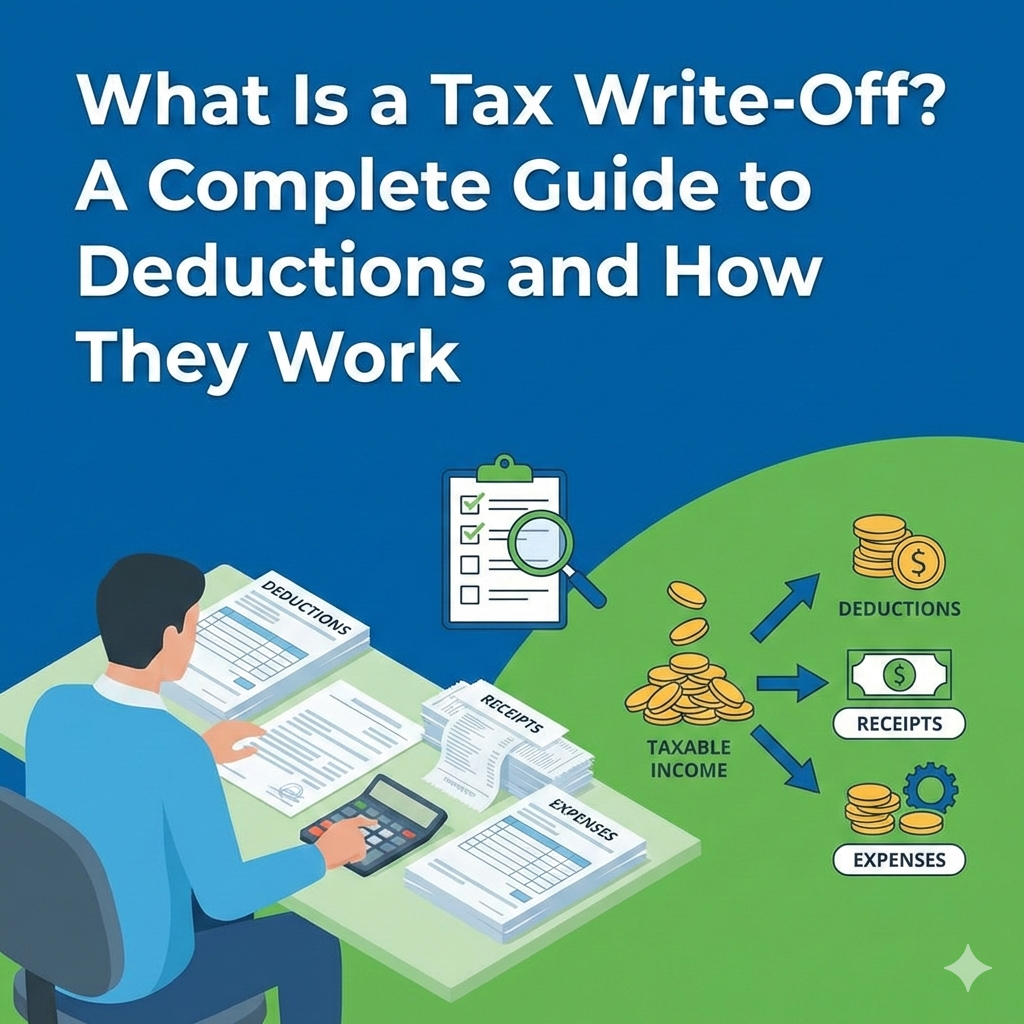
If you've ever wondered "what is a tax write-off?" you're not alone. Tax write-offs are one of the most powerful tools for reducing your tax burden, yet many taxpayers don't fully understand how they work or which expenses qualify. Whether you're a business owner, freelancer, or employee, understanding tax write-offs can help you keep more money in your pocket come tax season.
A tax write-off, also known as a tax deduction, is an expense that you can subtract from your total taxable income. Essentially, write-offs reduce the amount of income the IRS can tax, which in turn lowers your overall tax bill. It's important to note that a tax write-off is not the same as a tax credit. While a write-off reduces your taxable income, a tax credit directly reduces the amount of tax you owe dollar for dollar.
For example, if you earn $60,000 per year and claim $10,000 in tax write-offs, you'll only pay taxes on $50,000 of income. Depending on your tax bracket, this could save you thousands of dollars.
The way tax write-offs save you money depends on your marginal tax rate, which is the percentage of tax you pay on your last dollar of income. If you're in the 22% tax bracket and you claim a $1,000 deduction, you'll save $220 in taxes ($1,000 × 0.22 = $220). The higher your tax bracket, the more valuable each deduction becomes.
Tax write-offs fall into two main categories: standard deductions and itemized deductions. Every taxpayer is entitled to claim the standard deduction, which is a fixed amount set by the IRS each year. For the 2024 tax year, the standard deduction is $14,600 for single filers and $29,200 for married couples filing jointly.
Alternatively, you can choose to itemize your deductions if your eligible expenses exceed the standard deduction amount. Itemizing requires more documentation and record-keeping, but it can result in significantly greater tax savings for those with substantial deductible expenses.
Individual taxpayers have access to numerous deductions that can significantly reduce their tax liability. Understanding which expenses qualify can help you maximize your tax savings each year.
Medical and dental expenses can be deducted if they exceed 7.5% of your adjusted gross income. This includes costs for diagnosis, treatment, prevention, insurance premiums (in certain cases), and even travel expenses for medical care.
State and local taxes (SALT) allow you to deduct state income taxes or sales taxes, plus property taxes, up to a combined limit of $10,000 per year. This deduction is particularly valuable for homeowners and those living in high-tax states.
Mortgage interest on your primary residence and one additional home can be deducted on loans up to $750,000. This is often one of the largest deductions for homeowners and can result in substantial tax savings.
Charitable contributions to qualified organizations are deductible, including cash donations, property, and even out-of-pocket expenses incurred while volunteering. Keep detailed records and receipts for all charitable giving.
Student loan interest allows you to deduct up to $2,500 in interest paid on qualified student loans, even if you don't itemize deductions. This is available for both federal and private student loans used for qualified education expenses.
Business owners and self-employed individuals have access to a much broader range of tax write-offs than employees. These deductions can dramatically reduce taxable business income and are crucial for maintaining profitability.
Home office deduction allows you to deduct a portion of your rent, mortgage, utilities, and home maintenance if you use part of your home exclusively and regularly for business. You can use either the simplified method ($5 per square foot, up to 300 square feet) or the regular method based on actual expenses.
Business vehicle expenses can be deducted using either the standard mileage rate (67 cents per mile for 2024) or actual expenses including gas, repairs, insurance, and depreciation. Keep detailed logs of all business-related travel.
Equipment and supplies used for your business are fully deductible, including computers, software, office furniture, and materials. For larger purchases, you may need to depreciate the cost over several years or take advantage of Section 179 expensing.
Professional services and fees such as legal fees, accounting services, offshore bookkeeping, and consulting are all deductible business expenses. This includes the cost of tax preparation services related to your business.
Marketing and advertising costs including website hosting, social media ads, business cards, brochures, and promotional materials are fully deductible as ordinary and necessary business expenses.
Business meals are generally 50% deductible when you're discussing business with clients, partners, or employees. Keep receipts and note the business purpose and attendees for each meal.
Insurance premiums for business liability insurance, professional liability insurance, and health insurance (for self-employed individuals) can be deducted as business expenses.
Education and training related to maintaining or improving skills in your current business are deductible, including courses, workshops, conferences, and professional publications.
Many taxpayers overlook valuable deductions simply because they don't know these expenses qualify. Educating yourself about lesser-known write-offs can uncover significant savings.
Job search expenses in your current field, including resume preparation, career counseling, and travel to interviews, may be deductible under certain circumstances, particularly for self-employed individuals.
Tax preparation fees for business-related tax preparation, including the portion of your tax software or accountant's fees that relates to business taxes, are deductible as business expenses.
Educator expenses allow teachers and educators to deduct up to $300 in unreimbursed classroom expenses, such as books, supplies, and equipment used in the classroom.
Moving expenses for active-duty military members moving due to a permanent change of station remain deductible, though this deduction was eliminated for most other taxpayers.
Gambling losses can be deducted up to the amount of gambling winnings you report, provided you itemize deductions and keep detailed records of both wins and losses.
Understanding what you cannot deduct is just as important as knowing what qualifies. The IRS has strict rules about which expenses are deductible, and claiming ineligible deductions can result in penalties or audits.
Personal expenses such as groceries, clothing (unless it's a required uniform), personal grooming, and commuting costs to your regular place of employment are not deductible. Political contributions, fines and penalties, and most club memberships (country clubs, social clubs) also don't qualify.
For business owners, expenses must be both ordinary and necessary to be deductible. Lavish or extravagant expenses, even if business-related, may be questioned by the IRS. Personal portions of mixed-use expenses, such as using a business vehicle for personal errands, cannot be deducted.
Proper documentation is essential for claiming tax write-offs. Without adequate records, you risk losing valuable deductions if the IRS questions your return. The burden of proof always falls on the taxpayer.
For every deduction you claim, maintain receipts, invoices, bills, cancelled checks, or bank statements. Digital copies are acceptable and often easier to organize than paper records. For business expenses, note the date, amount, business purpose, and people involved.
Consider using accounting software or mobile apps to track expenses throughout the year. This proactive approach is much easier than scrambling to reconstruct records at tax time. For vehicle expenses, maintain a detailed mileage log with dates, destinations, and business purposes.
Keep tax records for at least three years from the date you filed your return, though seven years is safer for important documents. For records related to property, keep them as long as you own the asset plus the required retention period.
While many taxpayers can identify basic deductions, working with tax professionals can uncover write-offs you might otherwise miss and ensure you're taking full advantage of every available deduction.
Accritic specializes in tax auditing and accounting services that help individuals and businesses identify all eligible tax write-offs. Their experienced team stays current with constantly changing tax laws and can spot deduction opportunities that might not be obvious to the average taxpayer. Whether you're a small business owner with complex expenses or an individual looking to optimize your tax strategy, Accritic's comprehensive services ensure you're not leaving money on the table.
Professional accountants can also help you plan strategically for future tax years, advising on timing of expenses, business structure decisions, and recordkeeping systems that maximize deductions while ensuring full compliance with IRS regulations. The cost of professional tax services is often more than offset by the additional deductions and tax savings they help you identify.
One of the most important decisions you'll make when filing taxes is whether to take the standard deduction or itemize your deductions. The right choice depends on your individual financial situation and which option provides the greater tax benefit.
Take the standard deduction if your itemizable expenses are less than the standard deduction amount, you have simple tax situations without significant deductible expenses, or you want the simplest filing process with minimal documentation requirements.
Consider itemizing if you have high medical expenses, significant mortgage interest and property taxes, made substantial charitable contributions, experienced casualty or theft losses in a federally declared disaster area, or have other large deductible expenses that together exceed the standard deduction.
Run the numbers both ways or use tax software that automatically calculates the better option. Many taxpayers who previously itemized now benefit more from the standard deduction since it was nearly doubled by the Tax Cuts and Jobs Act of 2017.
Tax laws change frequently, and staying informed about these changes is crucial for maximizing your write-offs. Recent years have seen significant modifications to deduction rules that affect millions of taxpayers.
The Tax Cuts and Jobs Act made substantial changes including eliminating or limiting many itemized deductions, capping the SALT deduction at $10,000, and increasing the standard deduction significantly. These changes shifted the calculation for many taxpayers who previously itemized.
Business owners should pay attention to changes in depreciation rules, qualified business income deductions, and expense thresholds. The IRS regularly updates mileage rates, contribution limits, and standard deduction amounts based on inflation.
Consulting with tax professionals or using reputable tax software ensures you're applying current rules correctly and taking advantage of any new deductions or expanded limits that may benefit your situation.
Strategic planning throughout the year, rather than just at tax time, can significantly increase your eligible write-offs and reduce your tax burden.
Timing matters: If you're close to the threshold for certain deductions, consider bunching expenses into a single year. For example, making two years' worth of charitable contributions in one year might push you over the standard deduction threshold.
Keep immaculate records: Use digital tools, apps, or cloud storage to document every potentially deductible expense as it occurs. Retroactively reconstructing expenses is time-consuming and often results in missed deductions.
Understand your business structure: Your business entity type (sole proprietor, LLC, S-corp, C-corp) affects which deductions you can claim and how they're reported. Consider consulting with a tax professional about whether your current structure is optimal.
Don't overlook small expenses: Many taxpayers only track large expenses, but small regular deductions add up quickly. That monthly software subscription, those business parking fees, and professional dues all count.
Plan major purchases strategically: Understanding depreciation schedules and Section 179 expensing can help you time large equipment purchases for maximum tax benefit.
Understanding what a tax write-off is and how to use deductions effectively is fundamental to smart tax planning. Tax write-offs are legitimate tools provided by the tax code to reduce your taxable income, and taking full advantage of them is both your right and responsibility as a taxpayer.
Whether you're an employee with limited deductions, a homeowner with mortgage interest and property taxes, or a business owner with extensive deductible expenses, knowing which write-offs apply to your situation can save you thousands of dollars annually. The key is staying organized, maintaining thorough records, staying informed about tax law changes, and knowing when to seek professional guidance.
Remember that tax write-offs require proper documentation and must meet IRS guidelines to be valid. When in doubt, consult with qualified tax professionals like those at Accritic who can provide personalized advice based on your unique financial situation and ensure you're maximizing deductions while remaining fully compliant with tax regulations.
What is a tax write-off in simple terms?
A tax write-off is an expense that you can subtract from your total income to reduce the amount of income that gets taxed. For example, if you earned $50,000 and have $5,000 in write-offs, you'll only pay taxes on $45,000. Write-offs are also called tax deductions and are a legal way to lower your tax bill.
What's the difference between a tax write-off and a tax credit?
A tax write-off (deduction) reduces your taxable income, while a tax credit directly reduces the amount of tax you owe. If you're in the 22% tax bracket, a $1,000 deduction saves you $220 in taxes, but a $1,000 credit saves you the full $1,000. Credits are generally more valuable than deductions.
Can I write off personal expenses on my taxes?
Generally, no. Personal expenses like regular clothing, groceries, personal grooming, and commuting to work are not deductible. However, some personal expenses may qualify if they meet specific criteria, such as medical expenses exceeding 7.5% of your income or charitable donations to qualified organizations.
What business expenses can I write off?
Business owners can write off ordinary and necessary business expenses including office supplies, equipment, business travel, meals (50%), vehicle expenses, home office costs, professional services, marketing, insurance, and employee wages. The expense must be directly related to running your business to qualify.
Do I need receipts for all my tax write-offs?
Yes, you should maintain documentation for all deductions you claim. This includes receipts, invoices, cancelled checks, bank statements, or credit card statements. For business expenses, also document the business purpose, date, and people involved. Digital records are acceptable and often easier to organize than paper.
Should I take the standard deduction or itemize my deductions?
Choose whichever option gives you the larger deduction. For 2024, the standard deduction is $14,600 for single filers and $29,200 for married couples filing jointly. If your itemized deductions (mortgage interest, charitable contributions, medical expenses, etc.) exceed these amounts, itemizing will save you more money.
Can I write off my home office if I work from home?
Yes, if you're self-employed and use part of your home exclusively and regularly for business, you can deduct home office expenses. Employees working from home generally cannot claim this deduction. You can use either the simplified method ($5 per square foot) or calculate actual expenses based on the percentage of your home used for business.
What happens if I claim write-offs I'm not entitled to?
Claiming ineligible deductions can result in IRS audits, penalties, interest on unpaid taxes, and potentially having to repay the tax benefit plus additional fees. In cases of intentional fraud, consequences can be more severe. Always ensure your write-offs are legitimate and properly documented.
How far back can I claim tax write-offs I missed?
You can generally amend your tax return to claim missed deductions within three years of filing your original return or within two years of paying the tax, whichever is later. File Form 1040-X to amend a previous return. However, it's always better to claim all eligible deductions when you first file.
Do tax write-offs expire or have limits?
Some write-offs have annual limits, such as the $10,000 SALT deduction cap or the $2,500 student loan interest deduction. Others, like medical expenses, only apply above certain thresholds. Some deductions phase out at higher income levels. Tax laws also change, so write-offs available one year may not exist the next.